Community-led management
Planning shaped with the people whose lives and knowledge are part of the coastal landscape.
 CIE–Centre for International
Legacy programme · from 2008
The programme
The Tanzania Maritime and Underwater Cultural Heritage Development Programme connected three internationally significant coastal landscapes: Mafia Island, Kilwa Kisiwani and Zanzibar. CIE worked with national and local partners to strengthen practical skills, documentation and public awareness.
The programme treated maritime heritage as part of living coastal life. Archaeological sites, historic routes, fisheries, tourism and community memory were approached together rather than as separate subjects.
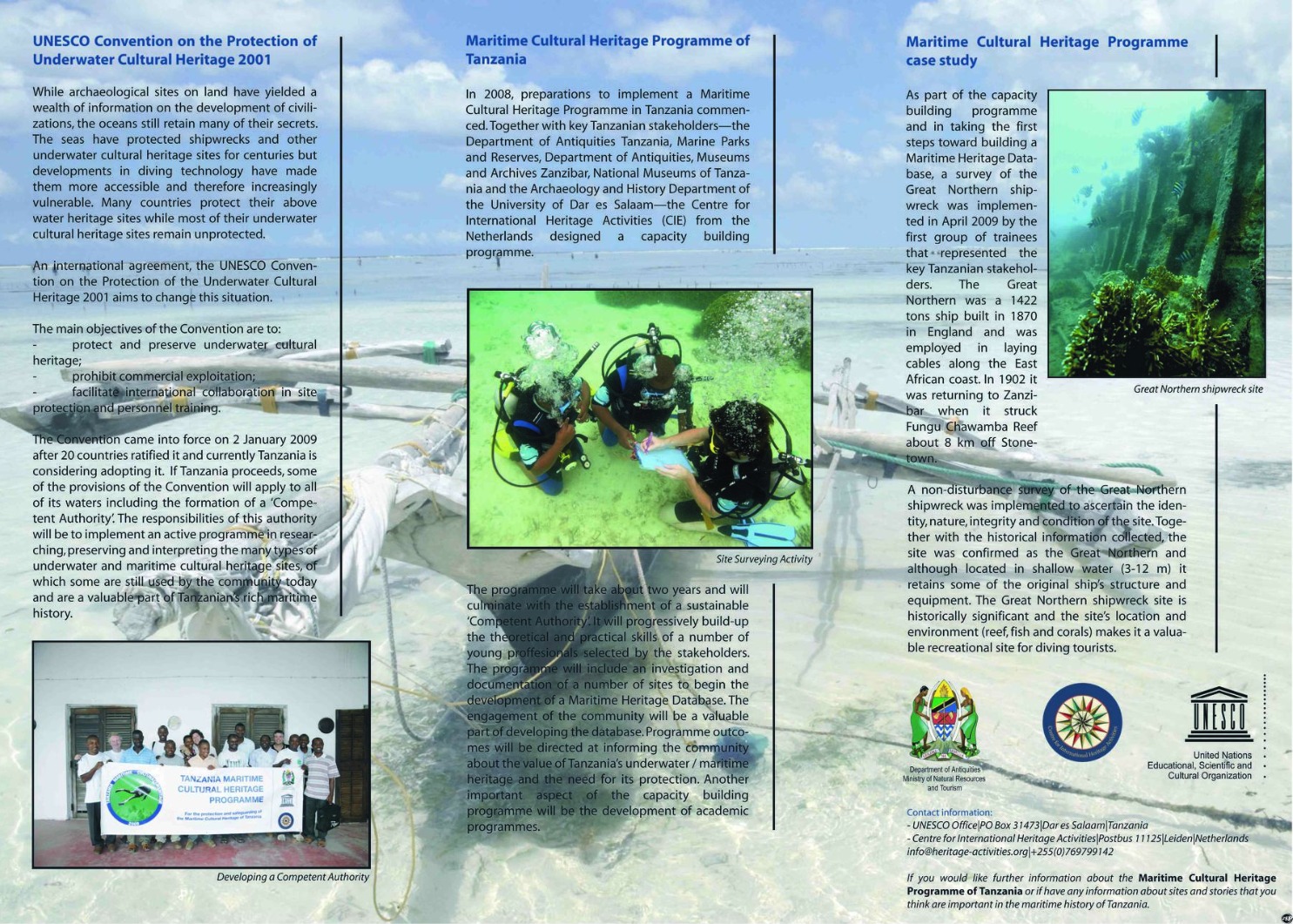
Programme framework
Field surveys and training were supported by memoranda of understanding, a developing maritime database and dialogue about sustainable management.
The resulting model linked technical work to education, community participation and regional cooperation along the East African coast.
Programme journey
A multi-place approach is established around Mafia Island, Kilwa and Zanzibar, with capacity building and community participation at its core.
Tanzanian participants develop field skills while work on the Great Northern and institutional agreements strengthens a national framework.
Survey and training focus on one of the Swahili coast’s most important cultural landscapes and its connected maritime evidence.
A workshop and documentation programme expand the shared record and support future management and research.
Legacy in today’s work
The programme established principles that continue in CIE’s work: locally grounded “better practice,” regional exchange, living maritime landscapes and public access to knowledge.
Planning shaped with the people whose lives and knowledge are part of the coastal landscape.
Field methods transferred through real sites, shared teams and long-term relationships.
Databases and documentation that make maritime evidence usable for research and management.
Experience shared across East Africa and wider Indian Ocean networks.